
Your PTA doesn't need more fundraising ideas. You need fundraisers that don't require a working group, three planning meetings and someone's entire half-term holiday.
The problem isn't ideas. It's hours.
This guide maps what it takes to run each one. Not just the idea, but the hours, the people, the permissions and the things that quietly go wrong. If you need £300 before half term and have one volunteer, start at the top. If you have eight weeks and a small team, work down to the bigger events.
This week (one person, one link)
Quick wins that require minimal coordination.
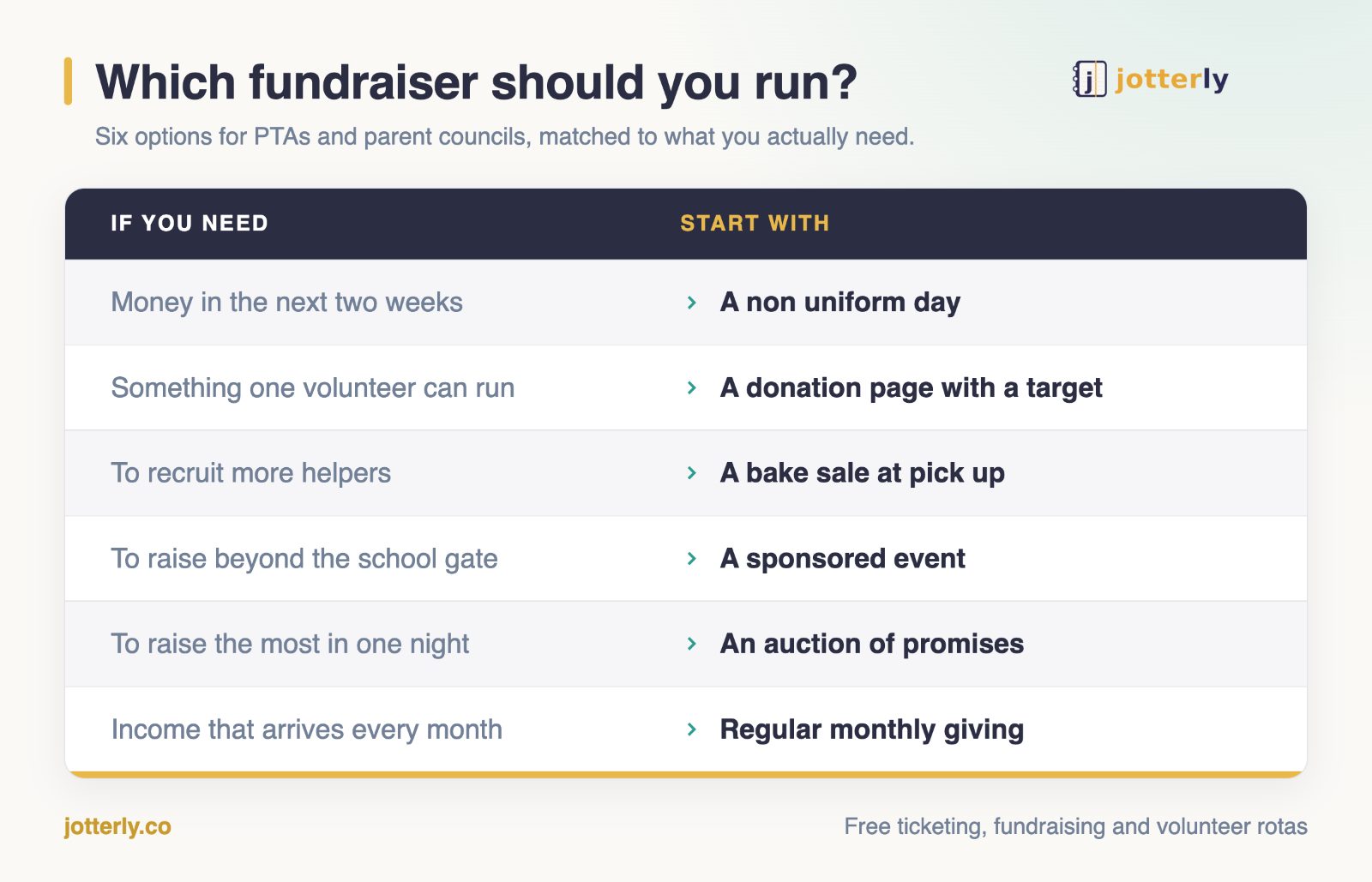
A non uniform day
Email your head to set a date, get a leaflet out to parents, collect by QR code or cash envelope. Three hundred pupils at £1 is £300. Twice a year is fine, any more starts to feel like a tax.
Just asking
Set a target, say exactly what the money is for and share the link. "We need £1,400 for playground equipment" raises more than "please support the PTA", because people give to a thing, not a committee. A page showing the total climbing does the chasing for you, so nobody has to keep posting updates in the class chat.
A second hand uniform sale
This costs nothing because the stock is donated, so every pound is profit. Runs at pick up or as one more table at an existing event.
Shopping cashback
Programmes like easyfundraising pay your community a small commission when supporters shop online. On its own each amount is nothing but sixty families across a school year can make a difference.
Employer match funding
Some large employers will match what a member of staff raises, pound for pound. It runs through an HR platform that checks for a charity number before it pays anything out, so this only works if your community has one. If you do, one line in a newsletter asking parents to search their staff intranet for "matched giving" costs you nothing, and one parent at the right company can match your entire sponsored walk.
Gift Aid
Gift Aid adds 25 percent to eligible donations if your community is a registered charity, at no cost to the giver. It requires upfront work but can make a real difference for schools with tight budgets.
This month (an afternoon and small team)
Half-day events that build team confidence and recruit new volunteers.
A disco
The disco is the workhorse of the school year. Cheap to put on, sells out in most schools, and you can run one every term without anyone getting bored.
Split it by infants and upper years so the hall never overfills. Add a tuck shop while you are at it, because it lifts the take for almost no extra work.
Running one for the first time? Start from the disco template. The two sessions, the entry and tuck shop tickets and the whole rota, door, tuck shop, hall supervision, setup and tidy up, are already filled in with sensible times. Change anything you like.
The capacity comes down on its own as tickets sell, so by Thursday you know whether you need another parent on the door.
On the night, keep it light. Minimal decor, and scan the code on each ticket from any phone. No printed lists, no crossing names off in the dark, no queue at the door.
A bake sale at pick up
This is your recruitment tool, not your money-maker. It earns the least per volunteer hour of anything here, but standing behind that table for forty minutes at the school gate is how you meet the parents who end up on your committee. No email has ever recruited anybody. Face-to-face does.
A movie night
A hall, a projector, and popcorn. Most local authorities hold a screening licence centrally that covers their schools, so check before you pay for one. The ticket is not where the money is. The snack table is. Keep entry cheap and stock the tuck shop properly.
A clothing collection
Companies collect the bags, weigh them, and pay by the kilo. Minimal effort for modest return, and the only fundraiser here where volume matters more than quality, so ask for everything rather than for good things. Run it in January, when every house in the catchment is being cleared out anyway.
A raffle at an event
This is the easiest money on this list. Sell and draw tickets at the event itself and it is exempt from licensing. The catch: timing matters legally, so check with your local authority if you're pre-selling in the playground.
A parent social event
A wine tasting, a skills workshop or a parent brunch builds community while fundraising, and reaches parents who might not volunteer for school events. Charge a modest ticket price and keep the setup simple. The value is in the gathering not the production. It is also the only night of the year when parents turn up without their children, which is why it is usually where your next treasurer comes from.
8+ weeks (working group)
Major events that reach beyond your usual donor base and generate serious money.
The summer fayre & the Christmas fair
These are the anchors of the school year. Stalls, tombola, teas. Most communities forget to charge pitch fees to outside traders. The hard bit is the rota. Use a link and let people sign themselves up to slots rather than chasing people in the chat.
A sponsored event
A walk, a read, a colour run, a sponsored bounce. The money comes from grandparents, aunts and colleagues in other towns, not the same forty families you always ask. Set the target, share the link, and let everyone watch the total move. Design it so a child can take part without a sponsor form. Every school has families who cannot fill one, and the activity itself should be something the whole year group does together with the sponsorship as optional.
An auction of promises
This has the best margin on this list because every item cost the person donating it an afternoon and nothing else. Local businesses and parents give a service instead of money. A haircut, a driving lesson, a weekend in someone's caravan, a head teacher who agrees to be a pupil for the day.
A Christmas card project
This converts well because parents are buying their own child's art, not a generic card. Order in October with pre orders rather than guessing print run. Unsold stock is where these usually lose money.
A night for the adults
A ceilidh, a race night, a quiz. It reaches a completely different crowd from the daytime events and they spend more. These also build the parent community in ways daytime events cannot. A race night means hiring equipment or bringing a company in, so agree who carries the liability before you book. If you want to sell alcohol you will need an occasional licence from your local licensing board, and they want a good few weeks of notice, so start that one early.
Every month (set once, runs itself)
Recurring revenue that arrives automatically, filling gaps between lump-sum fundraisers.
Regular giving
This is the only money that arrives without anyone organising anything, and almost no school community asks for it. A modest monthly commitment from supporters adds up to serious money over a year. Two things decide whether it works. The first is the amounts you suggest. Most people pick one of the options in front of them rather than typing their own, so those numbers effectively set what your average supporter gives. Put the one you actually want in the middle. The second is when you ask. Do it in the week after a fundraiser finishes, while people can still see what the last one paid for. That is the moment it is easiest to say yes.
What actually goes wrong
It is almost never the idea. It is one of these two.
Cash and one-person systems kill fundraisers. Every pound of cash gets counted, banked and reconciled by somebody, usually at eleven at night. Take the money by link instead and you know your headcount before you buy the sausages. The bigger risk is where it lands. If the money arrives in an account belonging to an individual rather than the community, you do not have a fundraiser. You have a favour, and it leaves when they do. Make sure two people can run it and the community owns it.
Asking for too much and not sharing results kill momentum. "Join the committee" is an enormous ask. "Sell six raffle tickets" is a small one, and the small one is what turns a parent into a volunteer. The same goes afterwards. Communities that publish what the money bought raise more next time, and it takes one photograph and two sentences. Send it to the people who actually gave, not the whole school. They are the ones who will give again.
Your Action Plan
This progression builds momentum without burning people out.
Step 1: Pick one thing from the first section and do it this month. A quick win builds confidence and shows what's possible when the admin doesn't fight you.
Step 2: Put one afternoon event in the diary. This gets people in the door and proves to your team that they can actually run events without drowning in spreadsheets.
Step 3: Choose one big fundraiser and start it eight weeks out. This is where you reach new donors beyond your usual forty families and build the sustainable revenue your PTA actually needs.
Step 4: Tell everyone what the last one bought. Sharing results isn't optional. It multiplies your next fundraiser's success because people give again when they can see their money did something.
Start with one thing this month. Pick a quick win, prove it works, then build from there. The system matters more than the idea.
When you are ready
Nearly every fundraiser on this list needs the same three things. A way to take the money, a way to know who is coming, and a way to tell everyone afterwards what it paid for.
That is what Jotterly is. Tickets, fundraising pages, donations, volunteer rotas and email to your supporters, all from one link you share in the same group chats you already use. A disco, summer fayre, film night or quiz can start from a template, so the sessions, tickets and rota are already there. It's free, and your community connects its own account so the money goes straight to your bank and never sits with us.
Set up your community in a few minutes and your first event can be live today.
General guidance, not legal advice. Your local authority licensing team is the right people to ask about raffles, lotteries and alcohol, and they are very used to being asked.