
Committees often look at DBS checks the week before an event. Most checks come back within two weeks, but some take over a month. Sort them at the start of the year and the rota is one less worry.
This guide is for PTAs, youth groups, sports clubs and community committees in England. In Scotland, read our PVG guide instead.
What changed in September 2026
Until this year, a volunteer working with children was usually exempt if a checked adult supervised them. From 1 September 2026 that exemption has gone. A parent listening to readers every week, an assistant coach or a regular youth club helper now needs an enhanced DBS check with children's barred list information, supervised or not.
The Department for Education guidance explains the change in full.
Occasional helpers are not affected. A parent at the summer fair or on a day trip does not need one.
Who needs a check
Two questions decide it.
1. Does the volunteer teach, train, instruct, care for, supervise or drive children? If not, stop here.
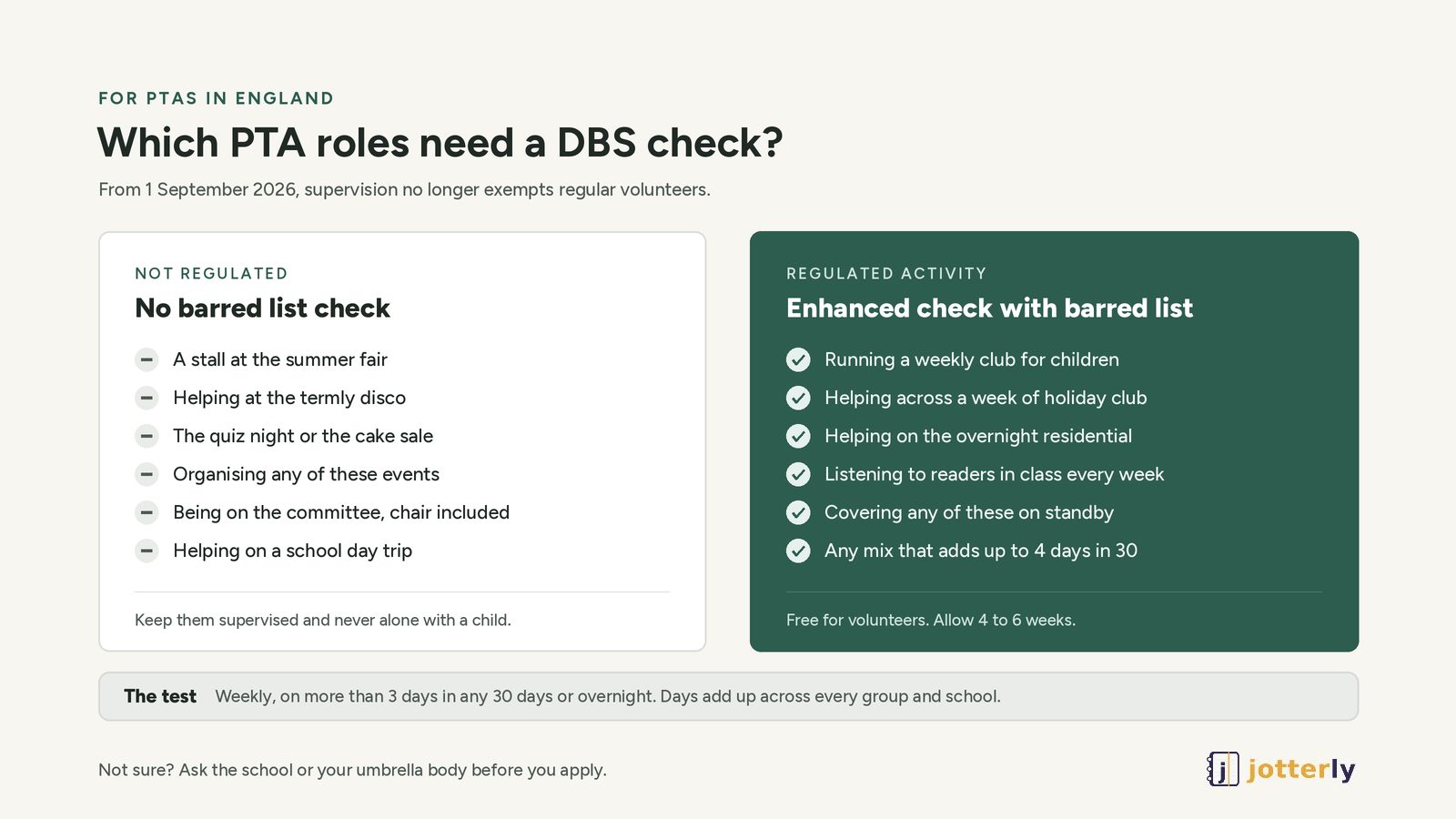
2. Do they do it once a week or more, on more than 3 days in any 30 days or overnight between 2am and 6am? If yes, they need a check.
Days add up across groups. Two reading club sessions and two football sessions in a month make 4 days in 30, so that parent needs a check even though neither group sees them often.
| Needs a check | Usually does not |
|---|---|
| Weekly reading helper or club volunteer | Helping at the fair, disco or quiz night |
| Assistant coach every Saturday | Day trips that are not overnight |
| Helping across a week of holiday club | Setting up, packing away, money or admin |
| Any overnight trip or camp | Committee meetings, including the chair |
| Regularly driving children to matches | Selling raffle tickets to adults |
At single events with unchecked helpers, make sure nobody unchecked is alone with a child or helps with toileting, and that a checked adult runs each area. The school may still ask occasional helpers for a lower level of check.
What this means for PTAs
Most of what a PTA runs sits outside regulated activity. A summer fair, a termly disco or a quiz night does not happen often enough, so the volunteers on those stalls do not need a barred list check, however hands on they are on the night. The school's safeguarding policy still applies, so keep them supervised.
Being on the committee does not need a check either, not even for the chair or whoever organises the disco. This is the opposite of Scotland, where anyone who decides how a children's activity runs needs a PVG.
The change bites on regular and overnight roles: a weekly club or holiday club the PTA runs, and parents helping on the residential. Watch for parents with two hats too. Someone who runs the disco and also listens to readers every week needs a check because of the reading, and the school will usually arrange it.
Cost, who applies and how long it takes
DBS checks are free for volunteers. Your group cannot apply directly, so ask the school first, then your local authority or sports body, or use an umbrella body. Some umbrella bodies charge an admin fee.
Care England publishes monthly DBS processing times. In July 2026, enhanced checks took 13 days on average, and checks referred to the police took 26 days. Allow 4 to 6 weeks, and never let a volunteer start a regulated role before the check is back.
Ask everyone to join the Update Service
The DBS Update Service is free for volunteers and must be joined within 30 days of the certificate being issued. Your group can then check a certificate online with the volunteer's permission, so one check can work for the school, the club and the youth group. This is the big difference from Scotland, where every group needs its own disclosure.
The checklist
- List every volunteer role and run it through the two questions
- Count days across groups for people who help in more than one place
- Check who already has the right certificate and who is on the Update Service
- Agree who applies: the school, your local authority or an umbrella body
- Apply at the start of the year, allowing 4 to 6 weeks
- Give regulated roles only to volunteers whose checks are back
- Keep a record: name, role, level of check, certificate date and Update Service status
- Ask new families to volunteer early and start their checks straight away
- Review once a year and before every overnight trip
On Jotterly, each event has a volunteer page with the slots you need filled, the times and how many people each one needs. You share the link, and volunteers create a free account and put themselves down for a slot. By default they are confirmed straight away and emailed the details. If a role needs checks first, switch off automatic confirmation in Settings, under Volunteers. Each sign up then waits for you to confirm or decline it, so you can make sure a volunteer has the required checks before you accept them. Jotterly does not run DBS checks or store certificates, so that check stays with you.
This guide covers England only. Scotland uses the PVG scheme, which we cover in our PVG guide. Northern Ireland uses AccessNI and Wales has its own schools guidance. This is general information, not legal advice.