
Committees sometimes check PVG arrangements shortly before an event, when they review the volunteer rota. This can cause problems because applications may take around six weeks to process. Completing the checks at the start of the year gives the committee more time to resolve any gaps.
This is the full guide for PTAs, parent councils, youth groups, sports clubs and community committees in Scotland. If you are a volunteer who just wants to know whether your role needs a check, start with our quick reference for volunteers.
Every children's activity runs on volunteers: the parents and neighbours who staff the tuck shop, coach the team, run the youth club and drive children to away games. Keeping those children safe is not optional admin. It is a legal requirement, and in Scotland that means the PVG scheme.
The rules changed in April 2025 and they are stricter than many committees realise. This guide covers what changed, how to tell which roles need a check, how long it takes and how to build a system that makes it easy.
What changed in 2025: from optional to mandatory
Before April 2025, groups had some choice about PVG checks. On 1 April 2025, PVG membership became a legal requirement for anyone doing a regulated role with children, paid or voluntary. Being small, informal or low risk does not exempt your group. If a role is regulated, the volunteer must have PVG membership through your group before they start.
- Since 1 July 2025, it has been a criminal offence to do a regulated role without PVG membership, or to give someone a regulated role if they are not a member.
- From 1 April 2026, PVG membership lasts five years from the day someone joins, then needs renewing. People who joined before then are being moved over in phases and will be contacted by Disclosure Scotland, so they do not need to reapply early. Keep a note of when each volunteer's membership runs out.
You also cannot rely on someone "probably having a PVG from work". If they do a regulated role for your group, they need a disclosure for your group.
Who needs a PVG check: understanding regulated roles
These rules apply to every volunteer-led group in Scotland running activities for children, whatever kind of group you are.
A volunteer needs PVG membership when their role includes a regulated activity and contact with children is a necessary part of it. For most groups, that means:
- Supervising or running children's activities and clubs
- Coaching or teaching children in sport, arts, music or drama
- Running a tuck shop for children on your own, with no staff or PVG checked volunteer in charge
- Escorting or driving children to away games, trips or other events
- Providing first aid at children's events
- Running a breakfast club, after school club or holiday scheme
- Supervising children at fairs, sports days or community events
- Being on standby to cover any of these roles
It is not about how often someone helps. It is about whether looking after children is part of the job. Someone who runs the bouncy castle once a year needs a check, just like someone who runs a weekly club.
Brief contact does not count. Someone selling raffle tickets who chats to a child in the queue is not looking after anyone, so they do not need a check.
Roles that usually do not need a PVG check
- Setting up or packing away when children are not there
- Handling money or admin with no contact with children
- Going to parent council or committee meetings
- Selling tickets or raffle prizes to adults
- Helping in the tuck shop with a PVG checked adult, never alone with children
- Giving the school suggestions about activities, where the school makes the decision
Committee members who decide how children's activities are run, such as organising the disco or the holiday club, do need a check, even if they are not there on the day.
Getting this right matters both ways. Requesting a PVG check for a role that does not need one is an offence under the PVG Act, just as failing to check someone who does.
When a parent or carer stays with their child
At stalls like face painting, crafts or Santa's grotto, it depends on whether parents stay:
- Parents stay: if the parent stays with their child the whole time and your volunteer is never alone with a child, the volunteer usually does not need a check.
- Children on their own: if parents can leave children at the stall, your volunteer is looking after them and needs a PVG check through your group.
Decide which it is for each activity before the day. If parents must stay, put up a sign and tell your volunteers. The person who organises the activity may still need a check, because they decide how it runs. If you are not sure, ask Volunteer Scotland Disclosure Services before the event.
The five step assessment: how to decide
Disclosure Scotland publishes guidance written for parent run groups with a five step check. Run every volunteer role through it.
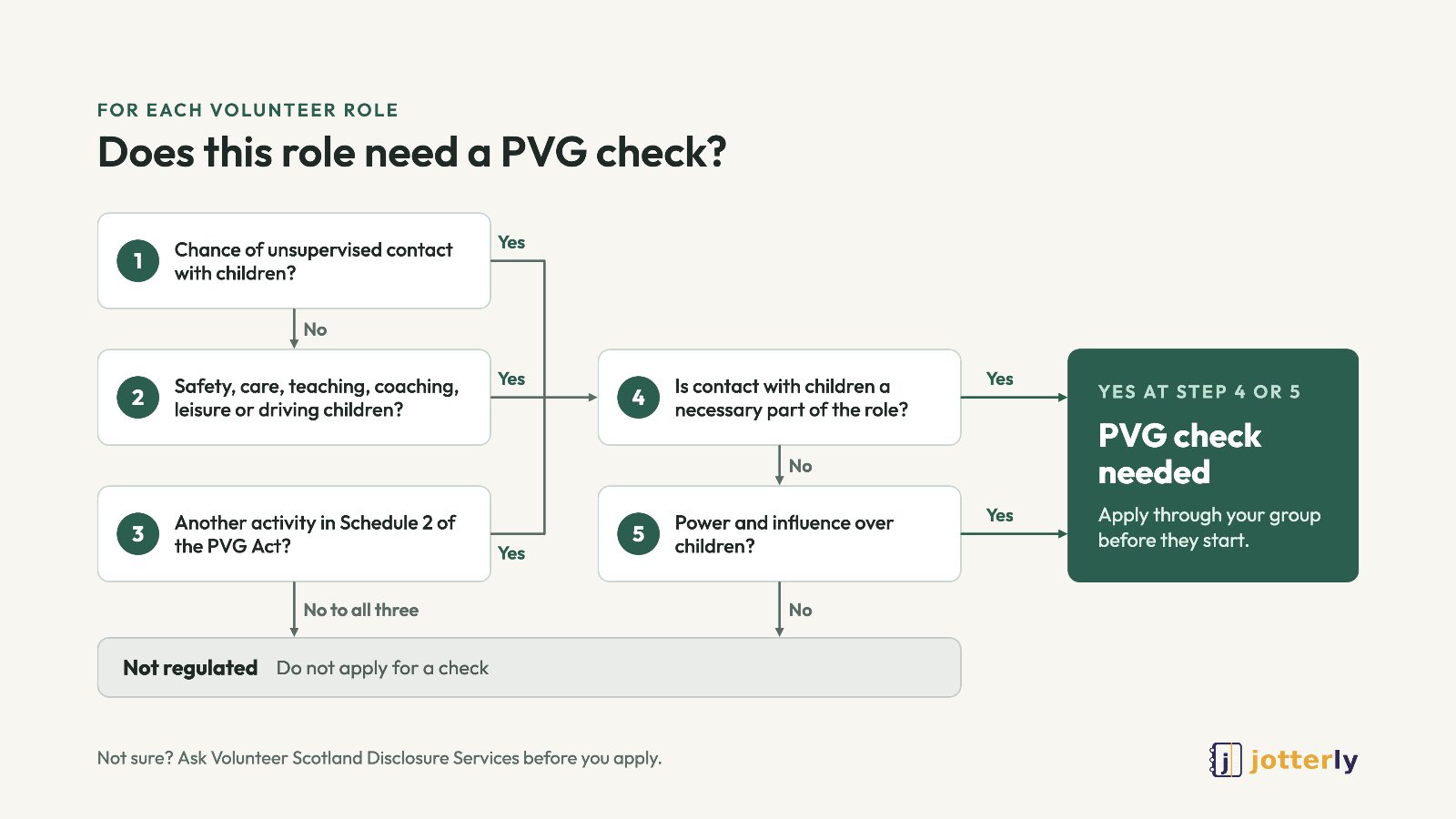
Step 1: Does the role take place in your organisation or venue with a chance of unsupervised contact with children?
Example: running the lunchtime tuck shop on your own, with no staff or PVG checked volunteer there. (PVG needed)
Step 2: Does the role involve common activities with children, such as being responsible for their safety, teaching, caring, leisure activities, coaching sport or driving and escorting them?
Example: supervising the bouncy castle at the summer fair. (PVG needed)
Step 3: Does the role involve another activity listed in Schedule 2 of the PVG Act?
If the answer to steps 1, 2 and 3 is no, the role is not regulated. Stop here.
Step 4: Is contact with children a necessary part of the role?
Example: helping at a breakfast club, serving food and supervising children. (PVG needed)
Step 5: Does the role involve power and influence over children?
Example: coordinating the youth club programme and setting the rules, even if you are not at every session. (PVG needed)
Write it down
Write a short description of each volunteer role, record the outcome of the five step assessment and keep it on file. If you are not sure whether a role needs a check, ask Volunteer Scotland Disclosure Services before you apply.
What it costs and how long it takes
For volunteers, it should cost nothing. Not for profit community groups, youth groups, sports clubs and PTAs usually qualify for free checks, as long as they are not run by the school or council as a formal service. Free checks go through Volunteer Scotland Disclosure Services, and your group needs to enrol with them first.
How long does it take?
Applications are online, but allow 4 to 6 weeks from applying to confirmation. September and October are busier, so it can take longer. Plan for six weeks and treat anything faster as a bonus.
A check is only done when your group has the confirmation. Until then, the volunteer cannot start a regulated role. So:
- Do not apply the week before an event
- Do not let a volunteer start before you have the confirmation
- Do not treat "it is in progress" as cleared
Keep a list of who you applied for and when. If there has been no update after eight weeks, contact Volunteer Scotland.
One disclosure per organisation: why you cannot transfer checks
PVG membership belongs to the person. A disclosure belongs to that person and one organisation.
Someone needs a separate disclosure for each group they volunteer or work with. A disclosure for one group does not carry over to another, even if both are at the same school.
For example, a teacher has PVG membership through their job and wants to help at your PTA's disco in their own time, as a volunteer rather than as school staff. Your PTA still needs to request a disclosure for them. Because they are already a member, it is usually quicker, but they still cannot start until your group has the confirmation.
This way, if a volunteer's circumstances change, your group is the one that gets told.
When to do it: build your system at the start of your year
The best time is at the start of your year, well before your first event. Disclosure Scotland's own advice is to write down your roles, plan the year's activities early and build up a pool of cleared volunteers.
At your first committee meeting of the year
Make PVG checks one of the first things on the agenda:
- List every volunteer role across the year, with a one sentence description
- Work out which roles are regulated using the five step check
- Check who already has a disclosure for your group, and when it expires
- Find the gaps and apply straight away
- Keep a simple record: name, role, confirmation date and expiry date
Anyone on standby to cover a regulated role needs a check too, not just the person who usually does it.
Leave a cleared pool for the next committee
If your committee is about to change, apply before you hand over. The new committee then starts the year with volunteers already cleared.
At intake time: catch new members
When new families join, ask early who would like to help. Put a simple form in the welcome pack: "Would you like to volunteer? We will start your PVG check now so you are ready when we need you." Your volunteer pool then grows every year.
The checklist
- List every volunteer role with a short description
- Check each role against the five steps and keep a record
- Decide which activities need parents to stay with their children
- Check who already has a disclosure for your group and when it expires
- Enrol with Volunteer Scotland Disclosure Services if you have not already
- Apply at the start of your year, allowing at least six weeks
- Make sure you have confirmation before anyone starts a regulated role
- Keep a record: name, role, confirmation date and expiry date
- Ask new members to volunteer when they join and start their checks straight away
- Review everything once a year
Next steps
If your group has not yet put a system in place, start by assessing the roles and submitting any required applications.
- Starting from scratch? Read Disclosure Scotland's guidance for parent run groups, list your roles, check which are regulated, enrol with Volunteer Scotland, apply and allow six weeks.
- Mid year and behind? Do the assessment today, apply now and only plan your next event around volunteers who are already cleared.
- Already on top of it? Keep going. Review once a year, ask new members about volunteering early and watch for renewal dates.
Do it once at the start of the year, and every event after that is one less thing to worry about.
This guide covers Scotland only. England, Wales and Northern Ireland use different systems with different rules. Last updated 13 October 2026.